
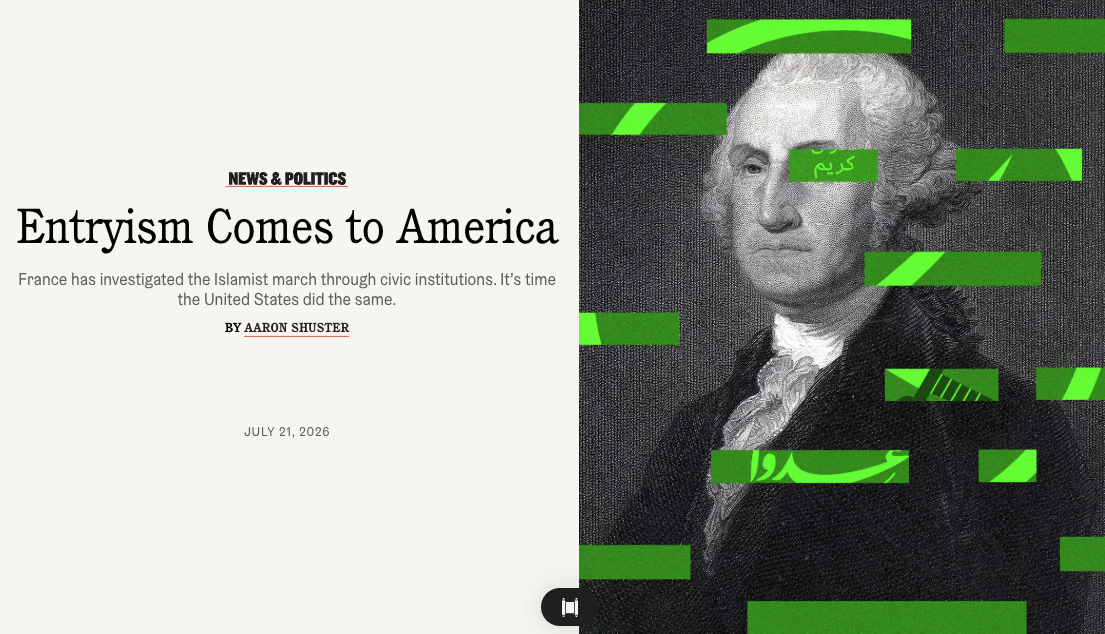
“Against the insidious wiles of foreign influence (I conjure you to believe me, fellow-citizens) the jealousy of a free people ought to be constantly awake, since history and experience prove that foreign influence is one of the most baneful foes of republican government.” —George Washington, Farewell Address, Sept. 19, 1796
France has completed the investigation America has yet to undertake. In May 2025, the French Interior Ministry published “The Muslim Brotherhood and Political Islam in France,” the product of a mission assigned to senior officials a year earlier. The inquiry examined political Islam, the Muslim Brotherhood’s role in spreading it, and the movement’s connections with affiliated European networks. French authorities concluded that the danger extended beyond jihadist violence. They described an assiduous campaign to acquire influence within the ordinary institutions of French life.
The actor France has identified is the Muslim Brotherhood and the political-Islamist ecosystem surrounding it. The method is entryism: the gradual penetration of schools, associations, religious institutions, charities, municipalities, political parties, and administrative structures. The objective described by French officials is the cultivation of communities in which Islamist norms gain authority while republican principles progressively retreat.
France has treated that finding as a threat to national cohesion. On May 5, 2026, the French Senate adopted legislation directed against Islamist entryism by a vote of 208-124. The measure seeks stronger powers to prevent, detect, and punish concerted institutional activity aimed at undermining the principles of the republic.
The legislation remains contested. Critics warn that vague definitions could cast suspicion upon ordinary Muslim citizens engaged in civic life. That concern deserves consideration. Washington himself cautioned that vigilance against foreign influence must remain impartial lest suspicion become another instrument of manipulation.
France nevertheless crossed an intellectual threshold that most Western governments have avoided. It distinguished private religious observance from a political movement that may employ democratic freedoms tactically while pursuing a comprehensive vision of law, society, education, and government. That distinction carries enormous consequences.
France is showing America what its future may hold.
The United States possesses many of the same warning signs and no comparable national inquiry.
Religious faith asks how man should live before God. Political Islam also asks who should govern, which law should prevail, what speech may be permitted, how the family should be ordered, and where political sovereignty ultimately resides. The French report concerns this political dimension and the Brotherhood’s stratagem for advancing it through institutions whose openness makes penetration possible.
What appears when France’s framework is applied to the United States?
The evidence begins with the public documents of Muslim political organizations themselves. Council on American Islamic Relations’ Muslims Vote operation lists a coordinated election program: Increase Muslim registration and turnout, document Muslim candidates, distribute national voter guides and congressional scorecards, survey Muslim political attitudes, cooperate with other Muslim organizations, and promote a unified “Muslim Policy Platform.” CAIR described its 2024 plan as a means of ensuring that Muslim voices would shape the national election.
EmgageUSA describes a similarly sophisticated infrastructure. Its 2020 annual report celebrated the launch of Million Muslim Votes, a national campaign designed to motivate and turn out at least 1 million Muslim voters after years of organizing and mobilization. Its current materials describe data-driven targeting, partnerships with allied organizations, leadership development, issue advocacy, and political representation.
The U.S. Council of Muslim Organizations – Civic Action Network traces its present mobilization effort to a One Million Voter Registration Drive launched in 2016. Its 2024 campaign sought record turnout and described Muslim voters as potentially decisive in Michigan, Pennsylvania, and Georgia. Its voter center provides registration tools, ballot information, contact with representatives, and resources for exploring candidacy.
USCMO-CAN’s political literature urges the construction of a unified Muslim voice and emphasizes the capacity of Muslim voters to shape domestic and international policy. One article declares that the community can produce “meaningful change domestically and globally.” Another tells politicians that Muslim voters represent the margin of victory in key jurisdictions and announces: “No justice for Gaza, no vote.”
Independent reporting confirms the scale of the movement. Voice of America reported in 2024 that hundreds of Muslim candidates were competing in local, state, and federal elections, with particular emphasis on city councils and school boards. Earlier reporting documented record numbers of Muslim candidates during the 2018 cycle.
None of these activities is inherently unlawful. American citizens may organize by religion, ethnicity, occupation, ideology, or common interest. Churches, unions, corporations, environmental groups, and civil-rights organizations all seek political influence.
France’s warning directs attention toward a deeper inquiry: What political conception animates the organization, and where does its ultimate allegiance lie?
Does a Muslim electoral apparatus seek fuller incorporation into America’s constitutional covenant? Does it cultivate a parallel communal identity designed to exercise leverage upon that covenant? Are candidates encouraged to represent every constituent under a common civil law or to serve as extensions of a religiously defined national bloc?
Numbers cannot resolve those questions. Organizational affiliations, foreign funding, private rhetoric, candidate training, policy platforms, and conduct in office can.
Entryism thrives on dissimulation. It presents each institutional advance as isolated and each inquiry as prejudice. The method relies on patience. One school board seat appears inconsequential. One municipal victory attracts little notice. One voter-registration program resembles ordinary civic engagement. One coalition agreement looks tactical. The larger architecture emerges only after the pieces have accumulated.
France’s investigators describe precisely such an ecosystem: religious institutions shaping communal life, associations distributing services, schools transmitting identity, local officials granting access, and political allies suppressing scrutiny. The danger lies in the cumulative power of institutions that reinforce one another.
America now exhibits several of the same structural features: mosque-centered voter outreach, unified policy platforms, strategic-state targeting, candidate identification, leadership cultivation, congressional scorecards, local-office campaigns, and a growing network of religiously defined political organizations.
Do those similarities prove that every named organization belongs to the Muslim Brotherhood? They do not. Do they establish that every Muslim candidate serves an Islamist project? They do not. They establish enough to justify the inquiry America has avoided.
Why has Congress never commissioned an investigation comparable to France’s? Why has the United States failed to map foreign financing, organizational interlocks, ideological affiliations, candidate-development programs, and political influence within municipalities, schools, bureaucracies, and established parties? Why does the mere proposal of such scrutiny so often produce accusations of bigotry before the evidence has been examined?
French Interior Minister Laurent Nuñez has identified the radical left as fertile territory for entryism because it frequently treats investigation itself as illegitimate. The alliance offers reciprocal advantages. Progressive parties receive a disciplined and expanding constituency. Islamist organizations receive access, legitimacy, institutional protection, and political influence.
The arrangement contains an unresolved contradiction. Political Islam’s historical positions concerning blasphemy, apostasy, sexuality, women, religious authority, and divine law conflict sharply with progressive commitments to secularism and personal autonomy. Electoral usefulness postpones the collision.
Will the left remain nonplussed when accommodation no longer serves the stronger partner? What happens when a coalition built upon convenience must choose between progressive social doctrine and an organized religious-political constituency?
America grants newcomers protection, economic opportunity, religious liberty, free expression, citizenship, and eventual participation in sovereign power. The contract imposes reciprocal obligations: allegiance to the Constitution, acceptance of civil law, equal citizenship, freedom of conscience, and loyalty to the country that confers those rights.
What becomes of the contract when America teaches newcomers what the nation owes them while declining to ask what they owe America?
Immigration without assimilation can produce residents who enjoy constitutional protections while retaining primary political allegiance to another civilizational order. Citizenship then becomes an administrative status detached from historical memory, national loyalty, and constitutional obligation.
That possibility should alarm a nation founded upon consent. The danger becomes chilling when the instruments of advance are America’s own freedoms. Religious liberty protects organization. Free speech protects ideological advocacy. Freedom of association protects networks. Elections provide access to power. Anti-discrimination law can deter legitimate examination. Each safeguard sustains a free society. Each may become deleterious when manipulated by movements seeking to transform the civilization that created it.
Washington warned against foreign influence because he understood that a republic could be redirected through domestic factions. The channels have multiplied since 1796: foreign donations, transnational religious networks, nonprofit organizations, political action groups, educational institutions, digital media, immigrant associations, and alliances within national parties.
A serious response should begin with investigation, not collective blame. Congress should establish a bipartisan commission on Islamist entryism and foreign political influence. Investigators should examine overseas financing, Muslim Brotherhood connections, nonprofit interlocks, foreign-agent compliance, tax-exempt partisan activity, mosque-based electioneering, candidate-training networks, and institutional influence. Public officials should disclose organizational sponsorship and foreign financial support. Existing election, tax, lobbying, and foreign-agent laws should be enforced without fear or favor.
America must also restore assimilation as a governing principle. Naturalization should signify entry into a constitutional civilization. Civic education should teach the nation’s history, rights, obligations, and civilizational inheritance. Public institutions should reject sectarian demands that compromise equal citizenship, freedom of expression, religious neutrality, or the supremacy of civil law.
France is showing America what its future may hold. France investigated the Muslim Brotherhood. It identified political Islam as an institutional challenge. It named the method entryism. Its Senate has begun constructing a response.
America possesses many of the same warning signs and no comparable national inquiry. How many local institutions must change before the pattern becomes visible?
How many political networks must announce communal strategies before scrutiny becomes permissible? How long can a republic protect liberty after losing the confidence to defend the constitutional order that makes liberty possible?
President George Washington conjured his fellow citizens to remain constantly awake. France has sounded the alarm. Will America examine the evidence while it still retains the power to act?