The True Darkness Of Barack Obama
[ CYPHER CODE #772 ]
Obama was not an phenomonon. He was a project.
[ CYPHER CODE #773 ]
Barry’s real legacy was never policy. It was rewiring.
[ CYPHER CODE #774 ]
The most dangerous leaders don’t conquer nations. They reshape them.
BRIEFING
Most people think they understand Barack Hussein Obama. They remember the well-crafted speeches, all his “ocean” symbolism, his swag and style, and all the (failed) promises of “hope and change.” But the real Obama is much darker. Darker than most of you even realize. Let’s get into it.
What gets missed when talking about Obama and his lack of “legacy” is that he was never meant to be a traditional leader. He was a constructed instrument who was shaped, polished, and advanced at exactly the right moment. Obama was never the “cartoon villain” the media has tried to turn Trump into. But in reality, he was something far more dangerous and effective. Obama was a figure who could soften resistance, disarm scrutiny, and move institutional levers without ever looking like he was forcing them.
This theory about who Barry really was/is is based on patterns. The expansion of surveillance, the normalization of intelligence agencies as political actors, and the quiet restructuring of power centers that outlived his presidency by a long shot. These are the observable outcomes, regardless of how warm and fuzzy he was presented. But what you don’t realize is that it was even worse than you realized.
What if Obama’s real legacy was not legislation or charisma, but a deeper rewiring of how authority, loyalty, and dissent function inside American institutions? If that is true, then his influence did not end when he left office. It just went underground, where it slithers around today.
What follows is a firsthand account from someone who claims to have operated inside the intelligence world during Obama’s rise to power.
The claim presented is stark and scary: Obama was identified early, cultivated very quietly, and advanced through networks most Americans never see. The presidency wasn’t the beginning of Obama’s power… it was just the public phase of a project already years in the making. According to this man’s first-hand account, the policies and decisions that followed were not random missteps or ideological drift but part of a longer game that knew institutional disruption was the key to real, raw power.
SOURCE
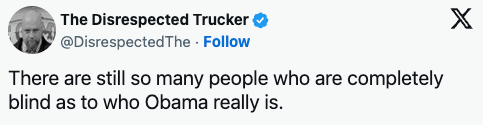
If this story holds water, then Obama was never operating alone. Power like that doesn’t move through just one man. It moves through networks, favors, pressure points, and alliances that don’t have party lines. That’s where figures like Lindsey Graham start to matter.
Graham’s long record of straddling loyalty and leverage looks less like confusion and more like a power play. And Trump pulling him close was not foolishness. It was likely containment. You don’t neutralize a pressure valve by pushing it away. You keep it where you can see it, manage it, and drain its usefulness.
To understand that system, you have to stop thinking of Obama as a man and start thinking of him as a product.
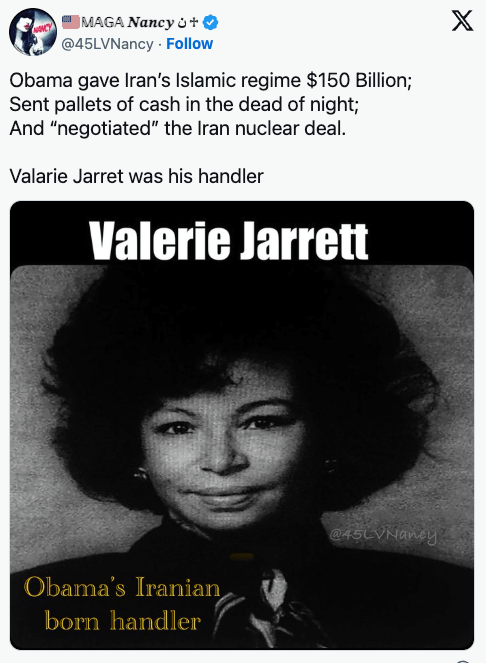
Political figures like Barack Obama are built, buffered, and propped up by layers and layers of handlers, donors, allies, and unelected power bigwigs who shape the outcome way before the public ever votes. That likely explains what happened with Iran, the pallets of cash, its nuclear program, and the role of a woman many believe was a key “handler,” Valerie Jarrett, who should ring a bell.
SOURCE
DEBRIEFING
What all of this exposes isn’t just one single man, but a political model. Power today isn’t just elected; it’s engineered.
Obama didn’t rise in some vacuum, and his influence didn’t disappear when he left office. It shifted form and deeply embedded itself deeper into institutions, alliances, and political mechanisms that will outlive any one administration.
Whether you see him as a willing participant or a perfectly shaped product, the result is the same…
Barry was a president who normalized ideological capture of the bureaucracy and totally blurred the lines between governance and activism.