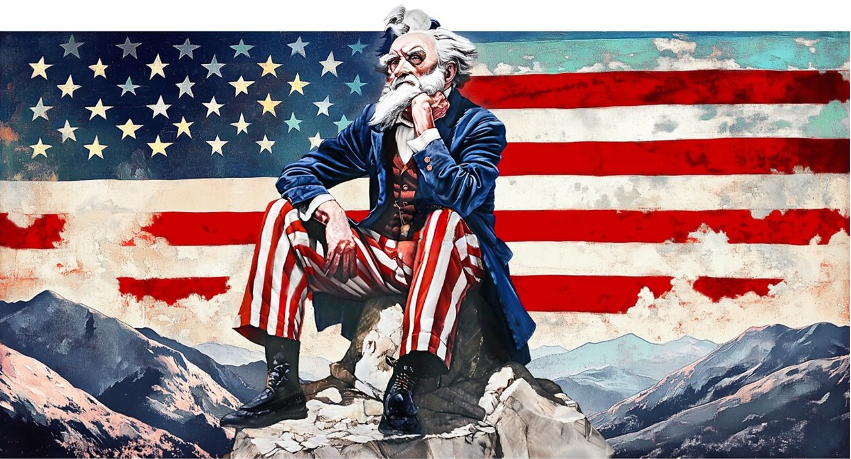
The Donroe Doctrine
By
From Venezuela to Colombia, President Trump has been putting focus on Latin America. Detractors criticize it as an effort to “control the Western Hemisphere.” According to many experts, Trump is working to address and counter growing efforts by America’s adversaries to gain inroads and control close to home, Mikenzie Frost reports.
Transcript:
Since September, the U.S. military has made 20 lethal strikes on alleged drug boats in the Caribbean and eastern Pacific. At least 80 suspected narco-terrorists have been killed.
In mid-November, the U.S.S. Gerald R. Ford – the largest aircraft carrier in the U.S. fleet – arrived in the region as President Trump continues his war against drug-running boats allegedly linked to Venezuelan gangs – including Tren de Aragua – and Colombian cartels.
President Donald Trump: The way you look at it is every boat that we knock out, we save 25,000 American lives.
It’s all part of Trump’s plan to reshape the Western Hemisphere, similar to the historic Monroe Doctrine of then-President James Monroe in 1823 to keep European power out of the United States’ backyard.
The 21st century version, dubbed the Don-Roe Doctrine for Donald Trump, also aims to manage influences in our own hemisphere, including China, which has built economic and political power in Latin America.
On social media, War Secretary Pete Hegseth says the area “is America’s neighborhood – and we will protect it.”
As Trump flexes America’s might through tariffs and sanctions, trying to weaken the left-leaning, socialist leader of Venezuela – President Nicolás Maduro, who has been indicted as a narco-terrorist in the U.S. – the two leaders spoke by phone in late November.
President Donald Trump: “I wouldn’t say it went well or badly. It was a phone call.”
At the same time, Trump is bolstering right-wing partners, including Argentina’s President Javier Milei – who has shifted his country away from China and is now receiving new financial support from the Trump administration.
Daniel Di Martino is an economist born in Venezuela and now works in New York City at a think tank – the Manhattan Institute.
Daniel Di Martino: He became a great ally of President Trump himself. Why? Because they were both fighting similar forces. And he’s explicitly pro-American.
Treasury Secretary Scott Bessent argues getting more involved in Latin America will help the United States in the future.
Treasury Secretary Scott Bessent: We have a generational opportunity in Latin America to create allies.
Daniel Di Martino: I think that the ultimate goal of the Trump administration is for all of Latin America to be a friend of the United States, a very close ally, for this to be one united hemisphere in conservatism, in freedom, in law and order.
Mikenzie Frost: What does that do for the United States?
Daniel Di Martino: Where does illegal immigration come from? Mostly from Latin America. So you have less illegal immigration, which also means less crime, less drug trafficking.
As America’s influence grows, it may put pressure on U.S. enemies who are looking to increase their own presence in the region.
Venezuela has cozied up to China and Russia in the past. The infiltration has included an Islamic extremist terrorist group – Hezbollah.
Daniel Di Martino: Iran has been operating in the tri-border area between Brazil, Paraguay, and Argentina for many decades. Hezbollah is there. And that’s why I think President Trump is so interested in protecting the Western Hemisphere, creating this barrier, which is the Atlantic and the Pacific Ocean, from our enemies.
Mikenzie Frost: Other presidents have attempted to do similar things in terms of putting Latin America in some sort of focus. Have there been any success?
Daniel Di Martino: I think the closest you can come to any focus on Latin America like President Trump is maybe the Kennedy years, where Kennedy did a lot of trips himself to Latin America. The Bay of Pigs was a big failure because the U.S. didn’t step up and help the Cubans liberate Cuba. Because of that mistake and the fact that Cuba became a communist country and then expanded all over the region and the world, the rest of American presidents forgot about Latin America.
At home, Trump has largely fended off challenges – and questions – about the legality of the lethal force used in international waters.
Sen. Mark Kelly (D-AZ): It’s questionable, and the White House and Department of Defense could not give us a logical explanation on how this is legal.
Mikenzie Frost: After President Trump is done with his term and we see him exit this stage, how do you think these policies will be carried forward? And if they aren’t, what’s the harm to the United States?
Daniel Di Martino: If somebody like JD Vance or Marco Rubio are still involved in a future Republican administration, I think they will be carried forward. If the Democrats come back to office, my great concern is that they will actually use those policies to help leftists instead of conservatives.
As the president evolves his “America First” agenda, the challenge is whether a policy that’s stood the test of two centuries can adapt to a rapidly changing world.