
The Declaration of Independence At 250 – New Challenges and Enduring Principles
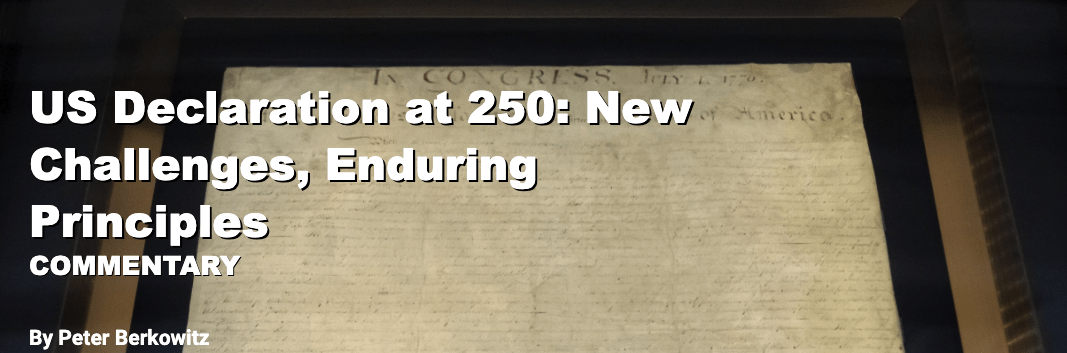

This was originally publish in a three-part series based on a lecture delivered on May 15 at a conference, “The Declaration of Independence at 250: What New Can Be Said?” hosted by the Stanford Constitutional Law Center at Stanford Law School.
It is a splendid series and is well worth reading. I will publish the complete documents with a summary of each preceding the full text of each.
Part I – May 24, 2026 – Summary
America’s founders created a nation 250 years ago rooted in the belief that all people are by nature free and equal, with government’s purpose being to secure those unalienable rights. No multi-religious, multiracial, multiethnic nation has more successfully established freedom under law.
Critics on the left and right now attack the Declaration’s universal principles, with progressives blaming them for systemic racism and post-liberals condemning them for degrading all citizens, yet both indulge fantasies of replacing America’s founding framework.
The nation’s educational system, particularly higher education, bears heavy responsibility for this diminished understanding. Colleges have debased liberal education through three radicalized ideals: political indoctrination that refuses to present opposing views, misguided application of scientific methods to moral questions, and professors training students as future scholars rather than informed citizens.
A proper curriculum would center on the Declaration, the constitutional system, Western civilization, and study of other cultures.
Part I – May 24, 2026 – Full Text
With the signing of the Declaration of Independence 250 years ago, America’s founders accomplished something new under the sun: They brought into existence a nation rooted in the belief that individuals are by nature free and equal. This year marks another achievement for the Declaration: Never before has a nation dedicated to securing its citizens’ unalienable rights – the rights inherent in all human beings – persevered for 250 years.
Notwithstanding the social and political turmoil currently roiling the nation, America has done much more than persevere. No multireligious, multiracial, and multiethnic nation-state in history has more successfully established freedom and equality under law, promoted economic prosperity, and developed the capabilities to defend itself by projecting military power around the world.
America’s perseverance and flourishing – as presidents including Abraham Lincoln, Calvin Coolidge, and Franklin Delano Roosevelt have affirmed and as venerable reformers such as Elizabeth Cady Stanton, Frederick Douglass, and Martin Luther King Jr. have demonstrated – owe much to the nation’s founding on universal principles and to its enduring dedication to them.
The self-evident truths proclaimed by the Declaration of Independence start with the conviction that human beings are by nature free and equally endowed with unalienable rights. They include the belief that government’s first purpose is to secure citizens’ unalienable rights, that just power stems from the consent of the governed, and that citizens by right may replace a government that destroys the conditions for securing their unalienable rights.
These universal principles inform the 27 grievances – abuses of executive power, lawless legislation, and acts of war – that the Declaration spells out against King George III and the British Parliament. Some argue that the Declaration’s primary significance lies in these grievances and downplay as Enlightenment commonplaces the historic document’s opening paragraphs about universal principles.
But it was revolutionary for a people to claim the authority of unalienable rights to throw off one form of government and institute another. Indeed, according to the Declaration’s logic, American colonists’ specific grievances justified their break with Britain and the establishment of free and independent states because taken together the grievances violated rights that the colonists shared equally with all persons.
In recent years critics on both left and right have subjected the truths that the Declaration holds to be self-evident to harsh criticism. Eminent figures associated with the postmodern-progressive left accuse these principles of obscuring if not empowering the evil institution of slavery. Prominent members of the postliberal right charge that the Declaration’s self-evident truths are neither true nor beneficial but rather constitute the chief source of the multifarious maladies afflicting the nation.
Whereas postmodern progressives blame those principles for the perpetuation of systemic racism, post-liberals condemn them for the systemic degradation of men and women of all religions, races, and ethnicities. Both find in the Declaration’s affirmation of universal rights a baleful pretext for colonizing foreign countries and imposing America’s ways and rules on other peoples and nations. And both indulge extravagant speculations about establishing new forms of government in the United States untainted by the basic rights and fundamental freedoms promised by the Declaration.
The American journey from 1776 to 2026 has been marked by the struggle to honor more fully the Declaration’s promise of equality in fundamental rights. America has benefitted from a common language; abundant natural resources; vast, protective oceans to the east and west; peaceful and stable borders to the north and south for much of its history; and a moral and political heritage entwining biblical faith, classical thought, and the modern tradition of freedom. At the same time, America has been compelled to grapple with the legal institutionalization of slavery and, after the Union’s victory in the Civil War and the subsequent ratification of the 13th, 14th, and 15th Amendments, slavery’s poisonous legacy; to wage war abroad repeatedly; and to reckon with the constant churn and turbulence generated by free peoples and free markets.
American citizens’ appreciation of this complex, rocky, and inspiring journey is waning. The nation’s educational system bears heavy responsibility for the diminished understanding of the American experiment in ordered liberty and for the popularity of extreme criticism emerging from both sides of the political spectrum. All levels of the American educational system have been derelict in their duties. But higher education is especially to blame because it also trains K-12 teachers.
American colleges and universities advance the public interest in a variety of ways. They furnish pre-professional and professional education. They provide a credentialing service for employers. They train scholars. They conduct vital scientific research. And, not least, they offer liberal education.
Liberal education is the least successful part of higher education. In recent years, reformers have justly focused on colleges’ and universities’ impairment of free speech and imposition of ideological monocultures. The corruption of the curriculum also deserves scrutiny.
In most cases, colleges and universities believe themselves to comply with the imperatives of liberal education by requiring students to fulfill distribution requirements. Rarely do the nation’s leading institutions of higher education mandate courses that all students must complete or identify substantive bodies of knowledge that all students must master.
Instead, students meet their obligations by taking a few courses in the humanities, the social sciences, and the sciences, often picking and choosing among dozens of offerings if not more in each of the three main divisions. Two students can fulfill their distribution requirements without reading a single book in common. This, from our colleges’ and universities’ point of view, is not a problem but rather a source of pride. They believe that they demonstrate concern for students’ individuality by allowing them to choose their own courses and design their own curricula.
At the same time, by exposing students to a variety of disciplines and approaches to knowledge, institutions of higher education claim to produce open-minded and well-rounded graduates expertly trained to lead in changing the world.
The traditional aim of liberal education is to cultivate students capable of thoughtfully exercising the rights and discharging the responsibilities of freedom. However, far from exemplifying liberal education at its finest, colleges and universities typically betray it by failing to structure the curriculum coherently, to give it suitable content, and to ensure that students master contending arguments. Few students these days receive an organized, historically informed introduction to American ideas and institutions: the nation’s religious and political inheritance, founding principles, constitutional traditions, cultural crosscurrents, economic arrangements, and diplomatic and national-security requirements.
Few students examine the great books and seminal events of the larger Western tradition out of which the United States emerged and to which it has made a decisive contribution. Few students undertake the serious study of other peoples and nations, which is essential to a proper assessment of American’s achievements and failings. And few students have impressed upon them the importance in studying morality and politics of appreciating the strong points of the arguments with which they disagree.
America’s colleges and universities have debased liberal education under the compulsion of three ideals. One is political. A second is methodological. A third is professional. When suitably refined, each is worthy. However, contemporary academic life has radicalized all three to the great detriment of liberal education.
First, contrary to liberal education’s imperatives, many faculty members believe that their job is to instill correct views about the pursuit of social justice and enlist students in the cause of progressive political transformation. Liberal education in America should not be neutral toward fundamental political principles: It assumes the goodness of individual freedom and human equality.
But to prepare students for freedom and democratic self-government, liberal education must both refrain from treating partisan political views as academic orthodoxies and foster appreciation of contending opinions and competing ideas. Yet many of today’s classroom crusaders recognize no pedagogical duty to present fairly the other side of the argument. Some believe themselves obliged to ignore, dismiss, or deride views – often despite little conscientious exploration of them and regardless of their historical significance and relevance to contemporary politics – that they deem distasteful, demeaning, or destructive.
They are unaware of or unmoved by John Stuart Mill’s indispensable observation in “On Liberty” that a person “who knows only his own side of the case, knows little of that.”
Second, contrary to liberal education’s imperatives, many faculty members in the social sciences believe that the scientific method represents the one true approach to understanding. While the application of the scientific method to the natural world since the 17th century has produced astounding increases in knowledge and know-how, the application of a method designed to account for matter in motion has been decidedly less successful in illuminating the moral and political world inhabited by self-interpreting human beings.
The conduct of moral and political animals, whose beliefs are shaped by custom, experience, reason, interests, and passions and whose actions are informed by fallible judgments about right and wrong, cannot be fully captured by methods designed to describe matter in motion. Nevertheless, setbacks in illuminating morality and politics have only driven many social scientists to double down on the study of method. Mesmerized by techniques for counting, measuring, and weighing and transfixed by elegant theories for describing rational conduct, they churn out mounds of research that shroud the substance and texture of human affairs. Political scientists’ bewitchment by method produces disciplines that have less and less to say to citizens about self-government and justice as they elaborate more and more mathematically sophisticated approaches to the study of moral and political life.
And third, contrary to the imperatives of liberal education, many professors operate on the assumption that the purpose of educating undergraduates is to train the next generation of scholars. Instead of transmitting to students the knowledge about America, the West, and the world needed for good citizenship, professors commonly provide intellectual tools and socialization into the sensibility required to succeed in the professoriate, though the vast majority of students have no intention of pursuing the scholarly life.
Curricula that honored the imperatives of liberal education would put the Declaration of Independence at the core. They would expose students to serious study of the constitutional system that institutionalized the Declaration’s fundamental principles and of the nation-defining political struggles to realize them. They would explore the seminal ideas and major events of Western civilization of which the American experiment in ordered liberty forms a crucial chapter. And they would examine the culture, economic system, language, politics, and religious beliefs of other civilizations, without which a well-rounded assessment of the United States is impossible.
Not least among the costs of colleges’ and universities’ betrayal of liberal education is that it produces graduates ignorant of the Declaration of Independence’s enduring principles and inspiring legacy and oblivious to the costs of that ignorance to themselves and the nation.
Part II – May 31, 2026 – Summary
Humanities and social science professors now equate critical thinking with thinking itself, spawning a rage to debunk venerable ideas and institutions, with social media multiplying the incentives for flamboyant denunciation.
All worthy thinking requires a critical component, but treating criticism as the essence of thinking drives professors to focus exclusively on defects. What’s missing is generous thinking, grasping the needs met and purposes served by inherited beliefs and institutions.
Plato showed this by demonstrating that common opinions about justice are partly true and partly false, not simply wrong. John Stuart Mill likewise argued that Bentham taught us to ask “Is it true?” while Coleridge taught us to ask “What is the meaning of it?”
Both the postmodern-progressive left and postliberal right deploy critical thinking against America’s founding principles while applying generous thinking only to their own preferred alternatives.
The progressive critique, indebted to Marx, sees systemic oppression permeating all institutions and demands comprehensive transformation. The post-liberal critique, drawing from Aristotle and Aquinas, condemns Lockean freedom as dehumanizing and seeks to replace constitutional government with rule aimed at moral excellence and salvation.
Both camps overlook neglected truths within America’s founding principles and the dangers endemic to regime change, failing to see that improving America depends on conserving the principles set forth in the Declaration 250 years ago.
Part II – May 31, 2026 – Full Text
Humanities and social sciences professors tend to regard “critical thinking” as the highest part of thinking or even equate criticism with thinking itself.
The apotheosis of critical thinking spawns a rage to debunk and excommunicate. Social media multiplies the incentives for flamboyant and extravagant denunciation. The more venerable the idea or institution, the more enticing the target and the more vehement the rhetoric.
In the spirit of the times, the postmodern-progressive left and postliberal right have unleashed multiple broadsides against America’s founding principles. As the United States celebrates its Declaration of Independence’s 250th birthday, the defense of the nation’s founding principles involves exposing the one-sidedness of the fashionable tendency to take critical thinking to an extreme. It also requires countering the extreme criticisms of the nation’s founding principles emanating from seemingly diverse precincts of the professoriate.
All worthy thinking about ethics and politics involves a critical component. The conviction that critical thinking represents the essence or epitome of thinking, however, induces professors to concentrate exclusively on the defects of inherited beliefs, customary practices, and established institutions.
It is one thing, though, to recognize that human beings are self-interested and fallible; that language is imprecise, ambiguous, and always open to interpretation and contestation; and that laws, institutions, and policies routinely fall short and rarely work as planned. It is quite another to insist that thinking’s principal task is to pinpoint people’s and institutions’ shortcomings, or, as the postmodern-progressive left and postliberal right sometimes seem to converge in supposing, that the supreme intellectual accomplishment is to expose the wickedness of the civilization of which one is a part.
Critical thinking must be combined with generous thinking. Grasping the needs met and purposes served by inherited beliefs, customary practices, and established institutions is also essential to understanding ethics and politics.
Plato and John Stuart Mill, great pioneers of liberal education spanning the divide between classical and modern thought, well understood that comprehending the merits of ideas and institutions is no less important than assessing their deficiencies.
In Book I of “The Republic,” Plato’s Socrates clarifies the limitations of three familiar opinions about justice: that it consists in telling the truth and discharging debts, that it revolves around benefitting friends and harming enemies, and that in practice it consists of nothing other than the advantage of the stronger. Socrates does not, as is commonly supposed, refute these opinions. Rather, he shows that each is inadequate, capturing an aspect of, but misleading by purporting to state the whole truth about, justice.
To understand justice in its complexity and fullness, Plato’s “Republic” teaches, one must grasp why the most common opinions about it are partly true and partly false. For example, it is usually just to keep promises, but sometimes returning what is owed would harm the recipient. Especially in war, justice requires benefitting friends and harming enemies, but we make errors about who, and what kind of people, our friends and enemies are; and harming people, whether friends or enemies, is the work of injustice.
And although some of what goes by the name of justice in any given society serves the selfish interests of the powerful, the very notion of selfishness reflects a conception of fairness and appropriateness that transcends short-term gain and love of dominion.
John Stuart Mill showed a similar appreciation of the combined roles of the spirit of criticism and the spirit of generosity in thinking about ethics and politics. In his tributes to the progressive rationalist Jeremy Bentham (1838) and the conservative poet Samuel Taylor Coleridge (1840), Mill argues that both provided lessons crucial to understanding human affairs.
Mill observes in his tribute to Bentham that to him “it was given to discern more particularly those truths with which existing doctrines and institutions were at variance; to Coleridge, the neglected truths which lay in them.”
In his tribute to Coleridge, Mill adds that both deserve the title “great questioner of things established,” but for questioning different aspects of established things. “By Bentham, beyond all others, men have been led to ask themselves, in regard to any ancient or received opinion, Is it true? and by Coleridge, What is the meaning of it?” wrote Mill. “The one took his stand outside the received opinion, and surveyed it as an entire stranger to it: the other looked at it from within, and endeavoured to see it with the eyes of a believer in it; to discover by what apparent facts it was at first suggested, and by what appearances it has ever since been rendered continually credible – has seemed, to a succession of persons, to be a faithful interpretation of their experience.”
Leading postmodern-progressive and post-liberal critics of America’s founding principles know how to think critically like Bentham and generously like Coleridge – but not as applied to the same set of beliefs, practices, and institutions. When it comes to America’s founding principles, they discern little beyond intellectual fraud and political iniquity. Concerning their preferred blueprints for fashioning novel institutional arrangements or restoring past glories, however, they see hardly anything but faithful expressions of human emancipation and flourishing. To restore balance it is necessary to think also generously where they condemn ardently and to think also critically where they praise enthusiastically.
The postmodern-progressive critique of America’s founding principles derives in large measure from Karl Marx and his 20th-century Frankfurt School acolytes. This is not to say that the postmodern progressives critics have read Marx or heard of the Frankfurt School, nor is it to deny the often-subterranean influence of Nietzsche, Heidegger, and Carl Schmitt, along with Derrida, Lacan, and Foucault. But with its characteristic conviction that ideological blinders hide the nation’s systemic injustices, its telltale terminology of oppressor and oppressed, and its utopian vision of fundamental moral and political transformation that overcomes injustice and ends oppression, postmodern progressivism betrays its debt to Marx’s enormously influential critique of individual rights, free markets, and democratic self-government.
Also like Marx, postmodern progressives overlook the self-correcting powers of rights-protecting democracies, the benefits of limited government, and the disadvantages of concentrated state power. And consistent with generations of Marxists in power, they exaggerate the abilities of managers, bureaucrats, and intellectuals to deliver services, allocate goods, and direct the people’s choices.
The postmodern-progressive critique comes in several versions. For example, Critical Legal Studies argues that, far from serving freedom and equality, the American system of equal rights under law rationalizes and insulates from scrutiny an unjust status quo in which the wealthy oppress the poor. Radical feminism as elaborated in the influential writings of law professor Catharine MacKinnon maintains that the fundamental divide in America stems not from class but from sex, enforcing a “male supremacist” society that afflicts women physically and psychologically, leaving it doubtful whether they can meaningfully consent to sex.
And Critical Race Theory contends that the American political tradition sustains and is sustained by a systemic racism that so thoroughly permeates the nation’s norms and is so deeply inscribed in its laws and institutions that only measures that discriminate based on race can overcome it.
These criticisms of America’s founding principles and constitutional system qualify as progressive because they are based on class, sex, and race. And they count as postmodern because they assert that oppression goes all the way down, operating not contrary to the principles and the system but rather as their clearest and most complete expression. Consequently, the postmodern-progressive critique necessitates a comprehensive remaking of society and politics.
The structure of the postmodern-progressive critique resembles that of the postliberal-right critique. Substitute freedom and duty for postmodern progressivism’s class, sex, and race, and moral and spiritual degradation for postmodern progressivism’s systemic oppression and, strangely enough, one approximates the structure undergirding the postliberal right’s criticism of America’s founding principles and constitutional system.
Instead of drawing from hypermodern ideas, however, the postliberal critique of America’s founding principles takes its bearings from pre-modern thinking, particularly Aristotle and Thomas Aquinas. It embraces the conviction that the highest aim of politics is to care for souls by fostering the virtues and directing people toward salvation.
At the same time, it overlooks the warnings advanced by both classical political philosophy and Christian thinking: While the best regime should serve as a standard, it is for all practical purposes unattainable; therefore, politics ought to consist for the most part in preserving and improving imperfect regimes in light of the best regime.
The post-liberal critique of America’s founding principles also comes in several versions. The two most influential have been developed by University of Notre Dame political scientist Patrick Deneen and Harvard Law School professor Adrian Vermeule.
In “Why Liberalism Failed” (2018), Deneen argues that the fatal flaws of the principles of freedom that undergird American constitutional government should now be visible to reasonable people. Foremost among those principles is the Lockean contention, central to the American Declaration of Independence, that human beings are by nature free and equally endowed with fundamental rights. In Deneen’s view – notwithstanding, among other considerations, Locke’s distinction between liberty and license, dedication to limited government, and elaboration of a lengthy catalog of virtues that enable free persons to flourish – equality in basic rights and fundamental freedoms entails a pure or total freedom that is impossible to achieve and dehumanizing to pursue.
To escape contemporary society’s corruption and decadence, Deneen counsels a retreat into small, tight-knit, self-governing communities. He does not notice that his counsel embodies the founding American idea of a nation of small, tight-knit, self-governing communities protected from despotism by a limited constitutional government that secures basic rights and fundamental freedoms.
He performs an unexplained about-face in “Regime Change: Toward A Postliberal Future” (2023). There he advances as the proper response to the ostensible breakdown of the American constitutional order the creation of a new regime that marries aristocracy and populism in order to promote virtue and care for the soul. Deneen evinces scant curiosity concerning what might be lost and what could go wrong in fundamentally transforming the American constitutional order.
In “Common Good Constitutionalism” (2022), Vermeule agrees with Deneen that classical liberal principles deform our politics and damage our humanity. In contrast to Deneen, though, Vermeule argues that America was not truly founded on them but rather owes more to classical legal principles deriving from Aristotle, Cicero, and Thomas Aquinas.
America’s debt to classical and medieval political philosophy, Vermeule maintains, obliges the legislative branch to make laws, the executive branch to execute the laws, and the judicial branch to decide cases and controversies that arise under the law not with a view to the principles of individual freedom and human equality but rather based on the highest truths about moral excellence and salvation.
Vermeule is right insofar as he contends that the wisdom of Aristotle, Cicero, and Thomas Aquinas illuminate the American experiment in ordered liberty. But the permanent contribution of Aristotle, Cicero, and Thomas Aquinas is no reason to deny, contrary to the stark evidence of the Declaration, that Lockean ideas about individual rights and limited government played a decisive role in the thinking of America’s founding generation.
That permanent contribution gives no grounds for ignoring or dismissing the common good as conceived by the American constitutional order, which consists in a system that protects individual rights while trusting individuals, within limits settled by law, to pursue happiness as they understand it. And it furnishes no justification for expecting contrary to experience – and the teachings of Aristotle, Cicero, and Thomas Aquinas – that those who govern will be well endowed with the wisdom to discern, the prudence to fashion and enact, and the piety to implement laws that minister to the needs of citizens’ souls.
For the post-liberal right as for the postmodern-progressive left, the principles animating the Declaration of Independence deserve exceedingly severe scrutiny while their own ideals warrant surpassingly indulgent treatment. Both fail to consider conscientiously the neglected truths within America’s founding principles and the reasons why so many Americans – and lovers of freedom around the world – have found them not merely credible but choice-worthy. And both overlook the disadvantages specific to their preferred schemes for radically transforming America and the dangers endemic to regime change, be it by the left or by the right.
One-sided thinking blinds the postmodern-progressive left and the post-liberal right to the dependence of improving America on conserving the principles the nation’s Declaration of Independence bracingly set forth 250 years ago.
Part III – June 7, 2026 – Summary
The Declaration of Independence affirms self-evident truths, chiefly that all people possess unalienable rights to life, liberty, and the pursuit of happiness, and that government exists to secure those rights with the consent of the governed.
Thoughtful conservatives and progressives both embrace this equality in rights, though they emphasize different means: tradition and order under law, or rectifying injustice through reform. Unfortunately, neither side always operates thoughtfully. Postmodern progressives deride founding principles as a mask for systemic oppression, while postliberals scorn them as the source of modern moral decay. Both distort America’s founding purposes.
The 2020 Commission on Unalienable Rights, chaired by Mary Ann Glendon, sought to reground human rights in America’s founding principles, the Constitution, and the Universal Declaration of Human Rights. Its report found enthusiastic reception from Indonesia’s Nahdlatul Ulama, demonstrating these principles’ cross-cultural appeal.
As America marks 250 years, recovering fidelity to the Declaration’s truths, through renewed liberal education and vigorous debate, is essential to repairing national rifts and preserving ordered liberty.
Part III – June 7, 2026 – Full Text
Respectable political opinion and salutary reform in the United States give concrete expression to propositions the U.S. Declaration of Independence held to be self-evidently true. In an 1825 letter, Thomas Jefferson maintained that these self-evident truths reflected “the common sense of the subject” at the time of the founding.
First among them is that human beings are equally endowed with unalienable rights – an 18th-century term for the rights inherent in all human beings – beginning with life, liberty, and the pursuit of happiness.
The Declaration also affirms as self-evident that government’s first responsibility is to secure the people’s unalienable rights, that government derives its just powers from the consent of the governed, and that the people have a right to alter or abolish government that destroys the conditions that make possible the common enjoyment of their unalienable rights.
Neither American conservatives, who focus on preserving tradition and respecting order under law, nor American progressives, who concentrate on rectifying injustice by improving existing arrangements and creating new ones, routinely put matters in these terms. Yet at their most thoughtful, both embrace the equality in rights in which the United States is rooted.
Thoughtful American conservatives recognize that in a rights-protecting democracy tradition and order under law sustain citizens’ effective and responsible exercise of equal rights.
Thoughtful conservatives also appreciate that in modern circumstances a system of equal individual rights creates conditions favorable to citizens’ maintaining their traditions and pursuing the good life as they understand it.
Thoughtful American progressives recognize that in a rights-protecting democracy rectifying injustice by improving inherited arrangements and creating new ones consists in significant measure in enabling the excluded to claim and enjoy the individual rights all share equally.
Thoughtful progressives also appreciate that in modern circumstances a system of equal individual rights creates conditions favorable to citizens’ mobilizing democratic majorities to enact legislation that ensures fair treatment for all.
That conservatives and progressives do not always operate thoughtfully is one reason that it is useful to return regularly to the study of the propositions that the nation’s founders held to be self-evidently true.
Another reason for careful reconsideration of the Declaration’s teaching about freedom, equality, and self-government is that influential professors – both of the postmodern-progressive left and of the post-liberal right – are inclined to repudiate the nation’s founding principles.
Postmodern progressives deride them as a mask for allegedly systemic oppression of minorities and women. Postliberals on the right scorn them as the source of the supposed systemic moral and political evils that plague contemporary America. In the process, postmodern progressives raise serious questions about dangers hidden within America’s unwritten norms, political institutions, and laws, while postliberals on the right draw attention to the excesses to which the principles and practices of freedom can be taken.
But the tendency of both to misconceive the roots and practical implications of America’s founding principles, to distort the purposes of American political institutions, and to obscure the common good at which the constitutional order aims exposes the disadvantages of derision and scorn as drivers of intellectual inquiry.
A third reason for attentively reexamining and restating the Declaration’s main ideas is the failure of colleges and universities to ensure that undergraduates gain an understanding of America’s founding principles and constitutional traditions.
As America celebrates its 250th birthday, the 2020 Report of the Commission on Unalienable Rights can contribute to giving the U.S. Declaration of Independence its due.
In July 2019, Secretary of State Mike Pompeo established the Commission on Unalienable Rights. Pompeo cherishes human rights as an essential component of the American heritage. Politicization of the great post-World War II human-rights movement by diplomats, professors, journalists, international organizations, and NGOs, he worried, jeopardized that heritage.
With a special interest in the place of human rights in a responsible U.S. foreign policy, Pompeo asked the commission to reground human rights in America’s founding principles, in the best of the nation’s constitutional traditions, and in the obligations that the United States embraced in 1948 in voting at the United Nations General Assembly to adopt the Universal Declaration of Human Rights (UDHR).
Pompeo appointed his Harvard Law School mentor, Professor Mary Ann Glendon, to chair the commission. Glendon’s unusual combination of accomplishments and virtues made her just right for the job. She possesses wide learning in law, politics, and religion. She authored two major books on rights: “Rights Talk: The Impoverishment of Political Discourse” (1991) explored the costs to democratic self-government of the proliferation of rights; and “A World Made New: Eleanor Roosevelt and the Universal Declaration of Human Rights” (2002) celebrated the UDHR’s achievement in advancing international appreciation of basic rights and fundamental freedoms as well as the responsibilities from which they are inseparable.
She served as Vatican representative to the UN’s 1995 Beijing Conference on Women and as U.S. ambassador to the Holy See from 2008 to 2009. And she possesses in abundance the rare ability to both generously interpret diverse views and subject them to rigorous criticism.
In my capacity as then-director of the State Department’s Policy Planning Staff, I served as the commission’s executive secretary, joining Glendon in assembling a small group of distinguished men and women to draft a report.
They brought to our task expertise in ethics, international law, comparative literature, political philosophy, sociology, African-American studies, and religion; backgrounds in Judaism, Christianity, and Islam; conservative and progressive political opinions; and experience in scholarship, law, and the promotion of human rights. Within that diversity of ideas, expertise, and experience and notwithstanding disagreements on public policy and law, commissioners shared a crucial conviction: All agreed that conserving America’s founding principles was vital to preserving and improving the nation.
The report consists of a prefatory note and five parts.
The prefatory note addresses the civic unrest and social convulsions that rocked the nation following the May 2020 murder of George Floyd by Minneapolis police officers. As it prepared to release its report to the public, the commission recognized that the tumult sweeping the country testified to America’s unfinished business in overcoming the nation’s long history of racial injustice.
At the same time, the report emphasized the fundamental distinction between rights-protecting democracies that fall short of their principles and authoritarian regimes that reject those principles. The report also stressed that despite the nation’s imperfections, America has been and should remain a beacon to those around the world struggling for human rights.
Part I introduces the undertaking. It reviews the erosion of the post-World War II human-rights project owing to diplomats’, intellectuals’, and activists’ abuse of rights language to advance partisan goals; international institutions’ disappointing performance as impartial upholders of human rights; and the resurgence of authoritarianism. It stresses the report’s focus on the principles that should inform the conduct of foreign affairs rather than on the advancement of specific measures. And it highlights the report’s multiple ambitions: to assist diplomats in weaving the defense of human rights into U.S. foreign policy; to renew American citizens’ understanding of, and dedication to, America’s distinctive rights tradition; and to encourage friends of freedom around the world to look to their own moral, political, and religious traditions for resources to elaborate and sustain the rights human beings share.
Part II concentrates on the Declaration of Independence. It discusses the roots of America’s founding principles in three traditions: Biblical faith, classical civic-republicanism, and the modern tradition of freedom. It examines the Declaration’s pioneering promise of equality in fundamental rights, the nation’s grievous departures from that promise, seminal reformers’ appeals throughout American history to the Declaration, and the dramatic progress the nation has made since its birth to honor more fully its founding promise of equality in individual rights.
It explores how the Constitution – through its institutional structure and formal guarantees, and its reliance on moral virtues and the associations of civil society that cultivate them – safeguards basic rights and fundamental freedoms. And it reviews the implications for foreign policy of the nation’s grounding in human rights.
Part III deals with the Universal Declaration of Human Rights. It recounts America’s leading role in drafting the UDHR and winning its approval in 1948 in the UN General Assembly. It explores the aim, structure and content, and logic of the historic document. And it provides answers to persistent questions about the UDHR concerning national sovereignty, the hierarchy of rights, the relation between civil and political rights and social and economic rights, states’ obligations to safeguard human rights, democracy and human rights, positive law and human rights, and the emergence of new human rights.
Part IV takes up human rights in U.S. foreign policy. It observes that securing American freedom has been at the core of American diplomacy – from Washington’s warning to the vulnerable new nation in his 1796 Farewell Address to steer clear of “permanent alliances” to America’s dependence in 2026 as a great power on a multiplicity of alliances and partnerships, formal agreements, and international organizations.
It argues that the growth of U.S. power and influence, the increasing interconnectedness of nation-states, and the horrors of World War II compelled Americans in the 20th century to assess the proper place of human rights in a responsible U.S. foreign policy, one that must balance a variety of vital interests and competing principles. It examines the constitutional and statutory bases of American human-rights policy and the nation’s obligations under international law and assumed through treaties.
And it reviews new challenges to human rights, including the decline of human-rights culture and the corruption of international institutions, resurgent authoritarianism led by the Chinese Communist Party, large-scale migration, global health and pandemics, the growing menace presented by non-state actors, and new technologies, particularly AI.
Part V offers concluding observations. Among the most important are that the UDHR recognizes the sovereign nation-state as the primary political entity for securing human rights, rights-protecting democracy is the regime best suited to safeguarding them, and respect for human rights begins with education and must be nurtured by families, schools, and the voluntary associations of civil society.
The commission’s report enjoyed a dramatic diplomatic success that demonstrated the power of the U.S. Declaration of Independence to inspire across national boundaries and the capacity of human rights to provide common ground for men and women of diverse religious traditions.
In the summer of 2020, a few weeks after the report’s publication, Nahdlatul Ulama reached out to me at the State Department. Headquartered in Indonesia, NU, the world’s largest independent Muslim organization with an estimated 100 million followers, champions an interpretation of Islam that emphasizes toleration, pluralism, and human dignity. A representative of NU’s general chairman, Kyai Haji Yahya Cholil Staquf, conveyed the organization’s enthusiastic agreement with the report’s understanding of human rights based on the U.S. Declaration of Independence, the American constitutional order, and the UDHR.
Our correspondence culminated with a visit by Pompeo to Jakarta in late October 2020 to present the report to NU. In 2022, Glendon and I discussed the commission’s report at the inaugural meeting of the G20 Religious Forum in Bali, organized by Nahdlatul Ulama under the auspices of the G20, which Indonesia hosted that year. And in the summer of 2025, Glendon and I conducted several seminars on Western political thought as part of NU’s launch in Jakarta of an educational program for its senior leadership combining the best of Islamic civilization and the Western tradition.
The appeal of the U.S. Declaration’s affirmation of unalienable rights to other peoples and nations suggests that America’s founding principles can also furnish common ground for repairing the rifts among American citizens.
Every generation in America faces challenges – some perennial, some distinctive – in bringing to life and living up to the moral and political principles enshrined in the nation’s Declaration of Independence.
The laziness, forgetfulness, and narrow partisan spirit that today plague both sides of the political spectrum are perennial vices. The broadsides against America’s founding principles from the postmodern-progressive left and postliberal right are distinctive to the moment.
The laziness, the forgetfulness, and the narrow partisan spirit as well as the intellectuals’ broadsides from the left and the right have been exacerbated by an education establishment that tends to neglect – where it does not outright deny – its responsibility to educate young citizens about America, and which often prefers to accentuate the nation’s actual flaws and even invent and propound new ones.
As the nation grapples with daunting challenges, it is vital to recall that in 1776 the U.S. Declaration of Independence accomplished something new under the sun by establishing a nation dedicated to securing its citizens’ equal basic rights and fundamental freedoms. And it is urgent to appreciate that, 250 years later, preservation and improvement of that magnificent achievement rest on fidelity to the nation’s founding principles.
Fidelity to those principles requires vigorous debate about how best to honor and implement them. To be fruitful, such debate should be informed by the reasoning that supports the nation’s founding principles, the traditions out of which they spring and which nourish them, their instantiation in the American political order, the gap between their promise and current realities, their appeal beyond America’s borders, and temptations presented by political alternatives.
Consequently, recovery of and rededication to the Declaration’s principles – undertakings that are today essential to conserving and improving the nation’s experiment in ordered liberty – hinge on reclaiming liberal education in America.
Peter Berkowitz is the Tad and Dianne Taube senior fellow at the Hoover Institution, Stanford University. From 2019 to 2021, he served as director of the Policy Planning Staff at the U.S. State Department. His writings are posted at PeterBerkowitz.com and he can be followed on X @BerkowitzPeter. His new book is “Explaining Israel: The Jewish State, the Middle East, and America.”